Wise in Appearance
October 2026
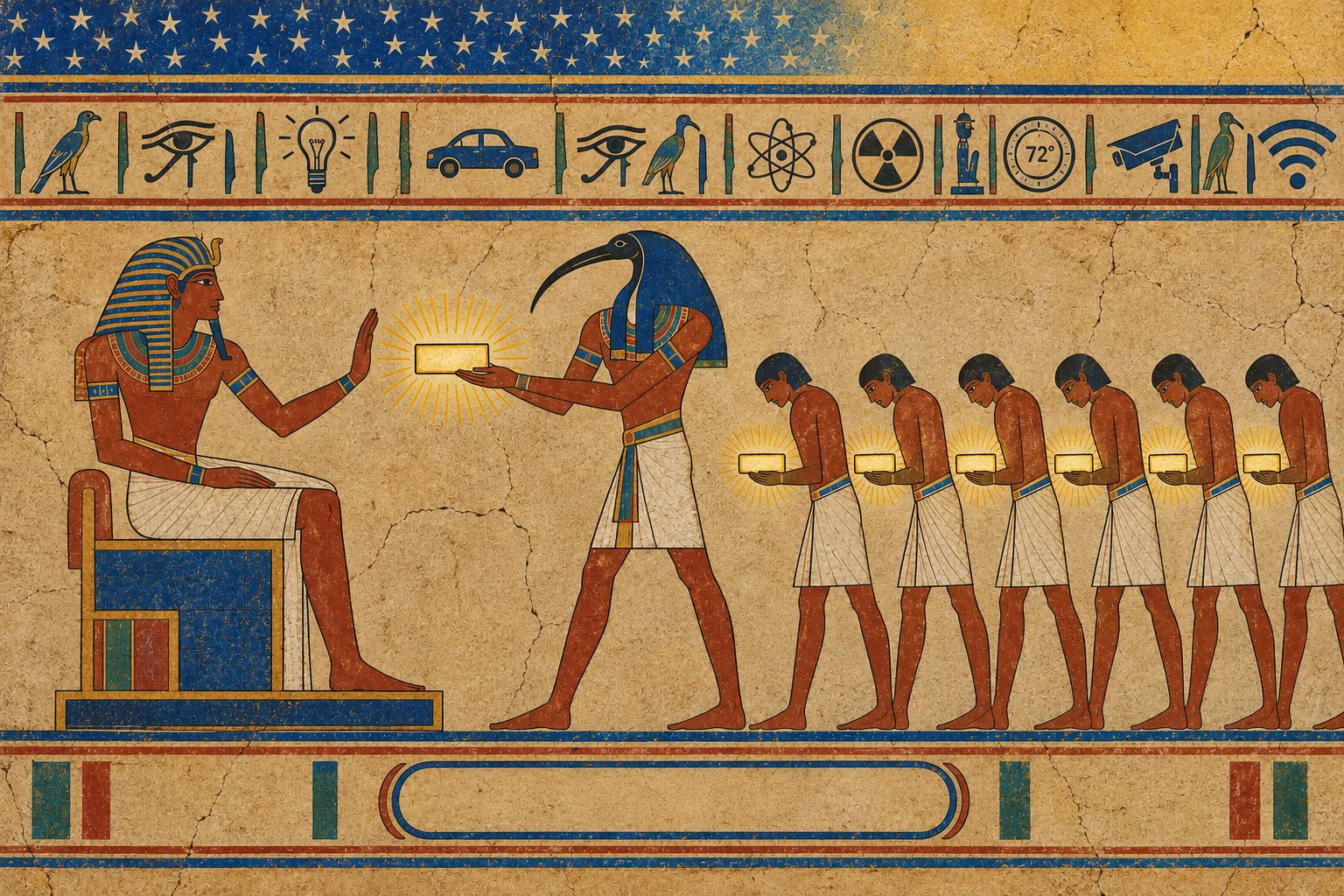
In the Phaedrus, Socrates tells a story about the Egyptian god Thoth, the inventor of numbers, geometry, astronomy, and letters. Thoth brings his inventions to King Thamus and saves writing for last, presenting it as a gift that will make the Egyptians wiser and improve their memories.
Thamus is unmoved. The one who creates a thing, he says, is not the one who should judge whether it helps or harms. Writing will not strengthen memory; it will weaken it. People will trust marks on a page instead of what they carry inside themselves, and they will seem wise without being wise.
For most of the last 2,400 years this story has been read as a small joke at Plato’s expense. And yet, the cost Thamus named was real. Oral traditions that could carry an epic in living memory are gone. Few of us can recite a single poem (or a phone number) from memory. The bill simply took centuries to come due, and by the time it did, no one remembered there had been a trade at all.
Neil Postman opened Technopoly with this same story and drew from it the lesson that every technology is both a burden and a blessing. Now consider when the cost arrives, and how little it may resemble what anyone was arguing about at the time.
If technology is a trade, the two sides of the trade are paid on different schedules. The benefit arrives at once. It is local, concrete, and felt in the body: the room is brighter, the pain is gone, the work is done faster. The cost may arrive later, over years, decades, sometimes generations. It is diffuse, abstract, and usually paid by people who were never asked.
This asymmetry is why we keep underpricing what we adopt. No one weighs a benefit they can feel tonight against a cost their grandchildren will feel. The ledger is rigged by time.
Often, the cost a society fears when it adopts a technology is not the cost it ends up paying. The feared cost is a decoy. It is visible, first order, and easy to argue about, so it absorbs all the attention. The real cost lives in the second and third order effects, in the slow way a technology rebuilds the world around itself until the new arrangement feels like nature.
Edison’s practical incandescent bulb arrived in 1879, and its benefits needed no explaining. You could read at night without squinting into a flame. Factories could run a second shift. Streets could be lit, and lit streets felt safe. Within a few decades whole cities glowed.
If anyone worried about a cost, it would have been the obvious one: the candlemakers, the lamplighters, the whale oil and kerosene trades. Those people did lose their livelihoods, and the economy absorbed them, as economies do. That was the decoy.
Now imagine telling someone in 1880 the real terms of the deal. In exchange for your candles, your great grandchildren will never see the stars. Not really. They will grow up under a sky the color of weak tea and learn about the galaxy they live in from photographs.
Our ancestor might have taken the deal anyway. That is not the point. The point is that the price was never on the tag. The phrase “light pollution” would have sounded preposterous. For the whole of human history, people looked up at night and saw where they stood in the cosmos. Every culture built its myths, its calendars, and its gods out of that sight. We gave it away without noticing we were giving anything.
The pattern repeats wherever you look. The automobile promised to take anyone anywhere, and it did. The feared cost was the horse trade and the livery stable. The real cost was the city: we tore out the streetcars, ran highways through neighborhoods, paved the squares for parking, and built suburbs no one could walk anywhere from. A century later Americans pay a premium for “walkability,” a word nobody needed when walking somewhere was simply what a town was for.
The atom promised power too cheap to meter, and the feared cost was a meltdown in someone’s backyard. The real cost was three generations raised under the standing possibility of instant annihilation, a dread so familiar we no longer notice it, and one that still sorts the world’s nations more decisively than wealth or ideology.
The pill promised women control over their own lives, and delivered it. Its bill is still arriving, in mood, in courtship, in the long slide of the birth rate, and the heterodox thinkers tallying it are still mostly treated as cranks.
That last one is what the lag feels like from the inside. The people naming the cost sound unreasonable, because the benefit is so obvious and the cost so slow. Thamus sounded unreasonable too.
Which brings us to the technology of our moment. The benefits of AI are already obvious and already felt. It is transforming knowledge work: writing, analysis, code, research, the whole white collar economy. In the near term it will move into robots and physical products, and blue collar work will follow. Every month it gets cheaper and better.
The cost everyone fears is jobs. Will AI replace the lawyer, the radiologist, the programmer, the truck driver? It is the question on every panel and in every op-ed.
This is the candlemaker mistake. Treating job replacement as the great cost of AI is like assuming the great cost of electricity would be unemployed chandlers. Displacement is real, and for the people displaced it will be painful. But it is first order and visible, which makes it exactly the cost society will argue about, legislate around, and eventually absorb. Labor markets have been rebuilt before. The cost we can see is rarely the one that changes us.
The costs that matter will come from the second and third order effects, and those are hard to see precisely because they are not about AI at all. They are about the world AI will quietly rebuild around itself. If the pattern holds, the people who collect the benefits will not be the ones who discover what they cost.
So what is hiding behind the decoy? Two things.
The first, yet again, is atrophy. Thamus warned that writing would let memory waste away, and he was right. AI offers the same bargain for thinking itself. Writing let us outsource remembering. AI lets us outsource reasoning, composing, judging, and deciding. The early evidence is not encouraging. In a small 2025 study at the MIT Media Lab, people who wrote essays with ChatGPT showed the weakest brain connectivity of any group, and many struggled to quote sentences they had produced minutes earlier. The researchers called it cognitive debt. A faculty that is not exercised does not hold steady; it declines. We may raise a generation that can produce anything and understands little of what it produced, wise in appearance and not in fact, exactly as Thamus said.
The second is surveillance. This is less a future risk than a present one, compounding silently. Digital technology has already given us a surveillance state. Everything you do online, and much of what you do offline, is recorded somewhere: where you go, what you buy, who you talk to, what you read and how long you lingered on it. It can and will be used against you. Not necessarily in a court of law, but in ways you will never see: the price you are quoted, the loan you are denied, the job that never calls back.
What AI changes is not the collecting. It is the reading. For decades the sheer volume of data was its own protection. No agency could listen to every call or watch every camera; there were never enough analysts. AI removes that limit. It can read every message, watch every feed, and correlate every record, tirelessly and at almost no marginal cost. The archive becomes an instrument.
Today’s surveillance state, as Shoshana Zuboff and others have noted, is felt mostly as intrusive ads and discriminatory targeting, harms that stay on the screen.
But as more of the physical world is connected, the instrument does not only watch. It acts.
Imagine the next domestic conflict, fought in a country where nearly every circuit is connected. Every watch and ring, every doorbell camera and car, every thermostat, every controller in every power plant and water system. Now imagine a faction, foreign or domestic, holding a system capable of reaching all of it at once.
Picture a summer afternoon in a city where every thermostat is cranked to maximum heat at the same moment. Homes become ovens. The grid buckles under the load. People cannot stay inside, so they pour into the streets, and the streets are watched by cameras that know every face. Then the tear gas starts to fall.
There are a million permutations of this, enough to fuel dystopian novelists for years. The point is not any single scenario. It is the category. The surveillance state of the twentieth century could watch you. The one we are building can reach into your home and act. That is the difference between a camera and a hand, and we are installing the hands ourselves, one smart device at a time, because each one is so convenient tonight.
So is this a warning or a lament?
Warnings assume foresight can change behavior. Thamus warned the king, and Egypt wrote anyway. Astronomers complained about streetlights, and the cities glowed anyway. Critics of the pill have been talking for decades, and the prescriptions keep coming. Read that way, every essay like this one is a lament written in advance.
But one thing is different this time, and it is speed. Writing took centuries to show its cost. Electricity took generations. The pill has taken most of a lifetime and is still not finished. AI may show its costs in years. That compression could break the pattern. For the first time, the people who feel the benefit and the people who pay the bill may be the same people, able to see both sides of the ledger at once. Thamus’s rule was that the inventor cannot be the judge. Perhaps this once, the judge will arrive before the inventor has left the room.