The Visible Hand That Feeds
September 2026
I. Before managers
For most of human history there was no such thing as a manager. Before roughly 1850, an enterprise was run by the person who owned it, and its size was capped by what that person could personally see. If he could not walk the floor, the floor did not get walked. Adam Smith could describe the economy as coordinated by an invisible hand because no visible hand was large enough to do the job.
The railroads ended this. A line running several hundred miles could not be overseen by any one person. Trains had to be scheduled, freight tracked, accounts reconciled, safety enforced by men who would never meet the man who paid them. So the railroads invented a new kind of worker: the salaried professional whose job was not to make or sell anything but to coordinate the people who did. Alfred Chandler built his career on this observation and won the Pulitzer for it in 1978. He called the new apparatus the visible hand, and argued that by the 1920s it had displaced the market itself as the primary mechanism for allocating resources in America.
What happened is noteworthy. A category of work was created that has no output. The manager produces nothing a customer buys. His product is the coordination of others, and its value cannot be easily measured, only inferred. Everything that follows lives in that gap.
The form was perfected at DuPont and then at General Motors, where Alfred Sloan organized a jumble of acquired car brands into the template: operating divisions reporting into a central office of staff functions, finance, planning, personnel, legal, all knitted together by tiers of general managers. It worked, and because it worked it was copied, not by carmakers but by everyone. Banks, retailers, chemical firms, and in time hospitals, universities, and software companies adopted Sloan’s structure, because it was the proven one, and because the business schools that grew up alongside it taught it as the shape a serious enterprise takes.
That is the first thing to understand about the modern organization. Its form did not grow from its function. It was designed once, for the problem of coordinating factories across a continent, and then inherited by institutions whose problems were nothing like that. The org chart is older than nearly everything inside it.
II. The job becomes the benefit
The second thing happened in the 1940s. In October 1942 the federal government froze wages to fight wartime inflation. Employers competing for labor could not offer more money, so they offered health insurance and pensions instead, and in 1943 the IRS ruled that an employer’s health contribution was not taxable income. A dollar routed through the company became worth more than a dollar in wages.
When the war ended, Truman proposed national health insurance, and the American Medical Association defeated it, twice, with a single word: socialism. The pressure went into the corporation instead. In 1948 the labor board ruled that pensions were a mandatory subject of bargaining. In 1950 the United Auto Workers signed the Treaty of Detroit with General Motors, trading five years of labor peace for company-funded pensions and health coverage. Steel, rubber, and coal followed, and non-union firms matched the terms to keep their people. Within twenty years the employer covered most of the country.
Historians call this welfare capitalism, and its Cold War logic was explicit. Anti-communist labor leaders argued that benefits won at the bargaining table proved capitalism could care for the worker better than Moscow could. The company pension was the free world’s answer to the five-year plan.
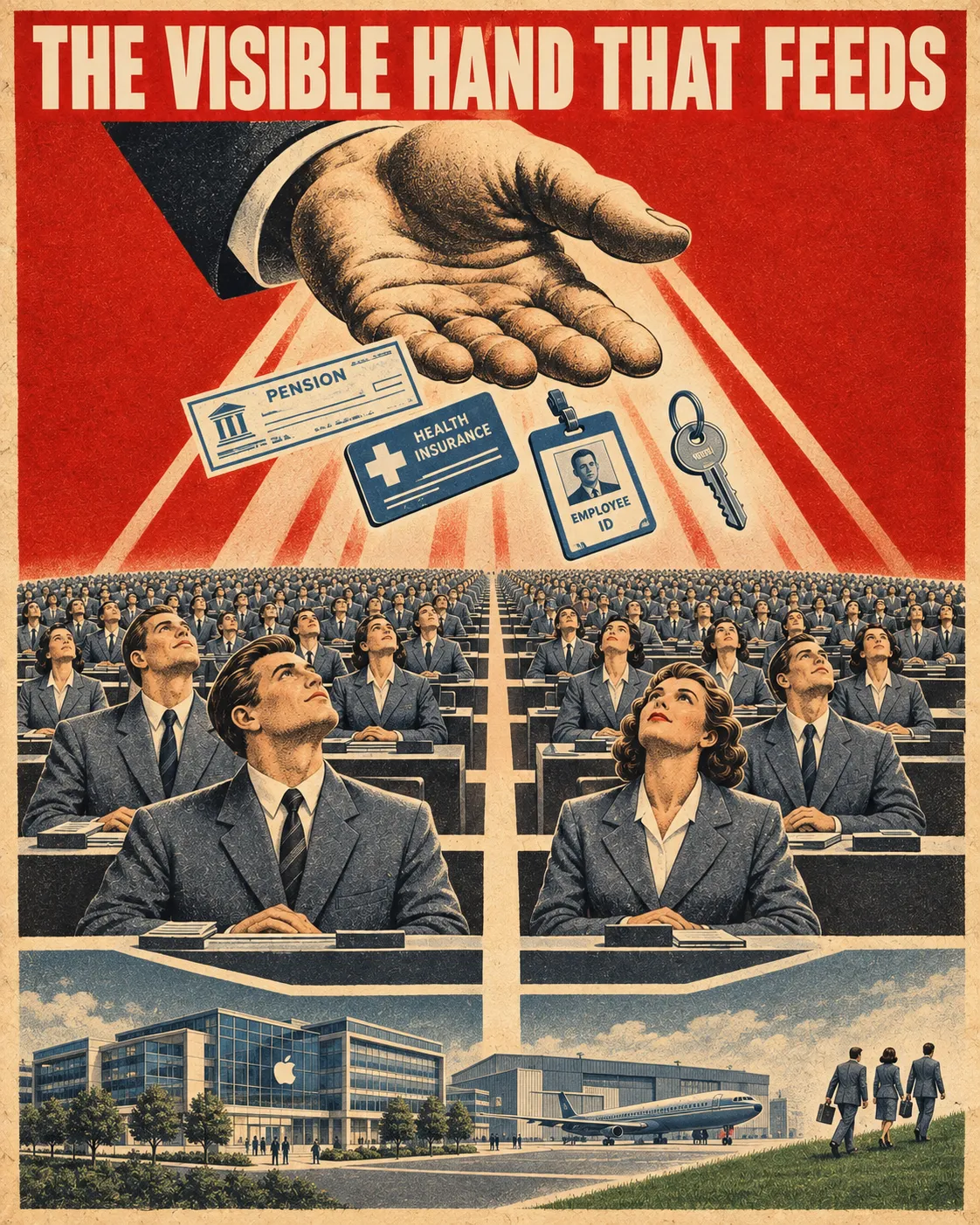
America did not adopt socialism, but it borrowed a core promise and gave it a private-market spin. The security that Europe delivered through the state, income, health care, retirement, and above all a guaranteed place in the order of things, was delivered here through the large employer. And once that happened, the job itself became the benefit. Not the wage, and not only the insurance attached to it, but the position as such: the desk, the title, the badge, the standing. A country that would never let the state guarantee everyone a place arranged for the corporation to do it, and called the arrangement a free market.
III. The shape hardens
What followed was the era in which the corporation became the central institution of American life, and it is worth noticing how quickly its shape stopped being a choice. William Whyte named the person who lived inside it in 1956: the Organization Man, who did not so much work for the company as belong to it. A generation raised on the Depression had been offered a place, and the place came with a pension, a doctor, a mortgage, and a desk. The size of a company, which meant the number of people it employed, became the ordinary measure of its importance, and the size of the company became the ordinary measure of the people inside it.
A year earlier a British naval historian named C. Northcote Parkinson had published a short article in The Economist that was received as satire and deserved to be received as a finding. Parkinson had looked at the Royal Navy between 1914 and 1928. The number of capital ships had fallen by two thirds. The number of sailors had fallen by a third. The number of Admiralty officials had risen by seventy-eight percent. Britain, he wrote, was building a magnificent navy on land. The Colonial Office told the same story: its staff grew fastest in the years the empire was dissolving and peaked when there were scarcely any colonies left to administer. Parkinson proposed two laws to explain it. An official wants to multiply subordinates, not rivals. And officials make work for one another. The growth, he calculated, ran at five to seven percent a year, irrespective of any variation in the amount of work, if any, to be done.
Parkinson thought he was describing the British civil service. He was describing the future of every organization built on Sloan’s template. The Admiralty had no shareholders to impress and no monopoly to protect. It grew because that is what a hierarchy of coordinators does when nobody can measure what the coordinators produce.
Boeing is the company to watch, because it began as the kind of company this was not supposed to happen to. In 1945 it was an engineering firm in Seattle that built airplanes, and it built the best ones. The Cold War made it something else. The federal government, which would not fund a national health service, funded bombers, missiles, the first stage of the moon rocket, and a supersonic airliner, and Boeing built them all, alongside the 707, the 727, the 737, and the 747. A company of engineers became the employer of a region. By 1967 it had 100,800 people on its payroll in Puget Sound. Then, in 1970, not one American airline ordered a Boeing airplane, the 747 ran far over budget, and in 1971 Congress killed the supersonic transport. Boeing’s local payroll fell to 38,690. Unemployment in Seattle reached 13.8 percent. That April two real estate agents paid $160 for a billboard near the airport that read: “Will the last person leaving Seattle turn out the lights.”
The Boeing bust is remembered as a regional recession. It is better understood as the first demonstration of what the arrangement of the 1940s actually was. When the employer is the safety net, the loss of the employer is not unemployment in the ordinary sense. It is the removal of the net itself, all at once, from an entire city. Nobody who lived through it concluded that Boeing had employed too many people. The lesson everyone drew was that the headcount must never be allowed to fall.
The one serious attempt to cut it came in the 1980s and 1990s, when the word downsizing entered the language. Jack Welch shed more than a hundred thousand jobs at General Electric and was called Neutron Jack for it, and every large company followed with a re-engineering program of its own. What was cut was the factory floor. The economist David Gordon went through the numbers in 1996 and found that the share of American private employment made up of managers and supervisors had risen through the downsizing decade, not fallen, and stood between fifteen and twenty percent, more than three times the level of Germany or Japan. The bureaucracy had not been downsized. It had done the downsizing, and grown in the process.
Boeing, meanwhile, came to look like every other large company. After it absorbed McDonnell Douglas in 1997, Harry Stonecipher, who came over from the smaller firm and eventually ran the combined one, said the change in culture had been the intent, so that Boeing would be run “like a business rather than a great engineering firm.” In 2001 the headquarters left Seattle for Chicago, half a continent from the factories, on the stated ground that proximity to the airplanes kept drawing executives into the business of building them. Boeing bends metal. Google serves advertisements. Yet by the 2000s both had a human resources department, a communications function, a strategy group, an internal audit department, quarterly planning cycles, and roughly the same number of layers between the chief executive and the person doing the work. If form followed from what an organization makes, a planemaker and an ad broker would be as different as a shipyard and a monastery. Their org charts are interchangeable, and so are Microsoft’s, and Facebook’s, and those of the hospital and the university down the road.
By the end of the century the form had hardened into something nobody inside it could see as a form. It was simply what a company was: a costume you put on to be taken seriously, whatever you made, and one you could never take off, whatever it cost.
IV. The squeeze
This is the world David Graeber walked into. His 2013 essay, and the book Bullshit Jobs that followed in 2018, collected hundreds of testimonies from people who believed, privately and often with shame, that their position should not exist. He sorted them into types: flunkies who exist to make someone look important, box tickers who exist so an organization can say a thing was done, taskmasters who supervise people needing no supervision. He blamed managerial feudalism, executives accumulating subordinates the way lords accumulated retainers.
That is true as far as it goes, and it does not go far enough, because it treats the situation as appetite rather than structure. The structure came first. The form was set by Chandler’s railroads and Sloan’s divisions before anyone alive today was born; the benefits were poured into it in the 1940s; Parkinson watched it grow on its own in the 1950s; and by the time Graeber’s respondents arrived at their desks, the desks were already there. Nobody hires a box ticker because they want one. They hire a box ticker because the shape has a slot in it and an empty slot reads as a deficiency.
This is the inversion. We imagine that work exists and people are found to do it, and in a company of ten people that is still true: everyone there is there because something needed doing. It stops being true at the first sign of success. Past product-market fit the company pours itself into the standard mold, and the reasoning is always the same: starting a company is hard enough without also reinventing how a company is organized. So the shape arrives whole, with its slots already drawn, and from then on people are squeezed into it. Once a person occupies a slot the work did not require, work must be invented for them, because an idle employee is a problem of its own. The invented work has no natural boundary, so it must be coordinated. Coordination generates reports, reports generate meetings, meetings generate the roles of people who prepare for meetings. Selling, once a single act of persuading someone to buy the thing, fractures into sales and marketing, two departments divided by a border no customer has ever perceived, and the border requires liaisons.
Jacques Ellul spent his life describing systems that behave this way. Technique, in his account, advances not because anyone decides it should but because every solution creates the conditions for the next, and the whole proceeds under its own momentum, indifferent to the people inside it. No one in 1950 resolved that America would guarantee employment by having corporations invent roles. The safety net was a byproduct of the costume, and the costume, once worn, kept growing. None of this makes the jobs fraudulent. The people in them work hard, are paid, and feed their children. The jobs are hollow in a different sense: the system requires them, and nothing outside the system does.
V. The veil comes off
An arrangement this large survives by being ordinary, and for seventy years it was. Individual observers saw through it, Parkinson in 1955, Gordon in 1996, Graeber in 2013, and seeing through it changed nothing, because everyone still had to go to the office in the morning. Then, in March 2020, nobody did.
Remote work was the first mass piercing of the veil. Output, by every measure the companies could report, held. Revenues rose. Products shipped. And a great many people sat at kitchen tables and noticed what fraction of the old day had been the performance of presence for an audience no longer in the room.
Alphabet, one of the most quantitative large companies in the world, studied the question internally. What it found was never published, but the number that circulated inside the company was a loss of forty to fifty percent against every metric it tracked. The moment public health guidance allowed it, in the spring of 2022, Google called everyone back to the office, and that July its chief executive told an all-hands meeting that productivity was not where it needed to be for the headcount the company had. Yet between 2019 and 2021, the years its people were at home, Alphabet’s revenue rose from $162 billion to $258 billion, and revenue per employee rose with it, from about $1.4 million to about $1.6 million. So what, exactly, had fallen by half?
Whatever it was, it was not the work that customers paid for. It was the other kind: the coordination, the preparation for meetings, the presence. It had been counted as productivity because the company had no other way to count it. The study had measured the costume, and for two years the costume had been off.
Artificial intelligence is the second piercing and it goes deeper, because it attacks the proxy itself. Headcount has stood in for capability for a century and a half because the two were correlated: more output required more people. AI breaks the correlation. When the artifacts of the work, the deck, the memo, the model, the summary, can be produced without the people who produced them, the question is no longer whether those people are efficient. It is what else they were for.
The technologists building these systems believe they are removing waste, and they talk about the coming disruption as though the displaced will be reabsorbed the way farmhands were absorbed by factories. What they have not reckoned with is that these positions are not surplus that markets will reallocate. They are structural. They are how the country delivers what other countries deliver through the state, and the structure will defend itself.
VI. Twitter and Washington
We have two natural experiments, and they are best read side by side.
When Elon Musk bought Twitter in 2022, he cut roughly eighty percent of the staff within a year, from about seven and a half thousand people to fifteen hundred. The service kept running, at roughly the same scale, with a fifth of the people. And Twitter was not a uniquely bloated outlier. It was an ordinary technology company with an ordinary org chart.
Then came the attempt to do the same to the federal government. DOGE arrived in 2025 with the same thesis and far larger ambitions: two trillion dollars, Musk had promised, close to a third of everything the government spends. It got a fraction of the way. By the following summer roughly one federal employee in eight had left, about half of them paid to go through a deferred resignation program rather than dismissed, and the auditors could not verify the savings that were claimed. Federal spending rose. Within months, agencies were hiring back into the same kinds of positions. The pattern was the one Gordon had found in the 1990s: the cutting was real, and the structure survived it.
A position that returns is not thereby shown to be useful. It is shown to be required, which is a different claim. The structure reasserted itself the way a costume reasserts its shape, and the work those restored positions do is, in the main, the same invented work it was before.
The real difference between Twitter and Washington is not operational. A private company sheds people onto somebody else’s ledger: the labor market’s, the family’s, the safety net’s. The federal government has no such elsewhere. Its employees are its constituents, and the consequences land in the same body that authorized the cut. Seattle learned this in 1971, and Seattle had lost only one company. Beyond government, the whole arrangement rests on tens of millions of private managerial and administrative positions that no state program stands ready to replace.
The ceiling was never capability. The federal government could run at a fraction of its size, in the narrow sense that Twitter could. What stops it is that nothing has been built to catch what falls. We decided, in the 1940s, that the job would be the safety net, and we have not revisited the decision since. Now a technology has arrived that dissolves the job and leaves the decision standing, which means that for the first time in seventy years the decision has to be made in the open, by people who know they are making it.
I think it will be made well, and not because anyone in charge is wise. It will be made well because the arrangement it replaces was never something anyone loved. Nobody dreamed as a child of becoming a box ticker. The Organization Man took the desk because the desk came with the doctor and the pension, and once the doctor and the pension can be had some other way, the desk has no constituency left. The money is not hard to find. It sits in the same companies whose machines are dissolving the jobs, and the shrewder of them already understand that a stable society is cheaper than an angry one.
What comes after is smaller and more ordinary than the futures on offer from the people building the machines. Work goes back to being something with an output. The person who used to prepare for the meeting about the meeting makes something, or teaches someone, or looks after someone, or builds a house, or grows food, or does nothing in particular for a while, which for most of human history was the ordinary condition of a Tuesday afternoon. A working life spent in front of a screen, which a whole country came to regard as simply what adulthood looked like, comes to seem a strange thing to have asked of a person. The org chart does not come down. People stop climbing it.
The visible hand fed a hundred million people for seventy years without anyone quite deciding that it should. It will not feed them that way much longer. What remains is the part that was always a choice and was never made as one: how to keep the promise without the costume.