Screen Lane
September 2026
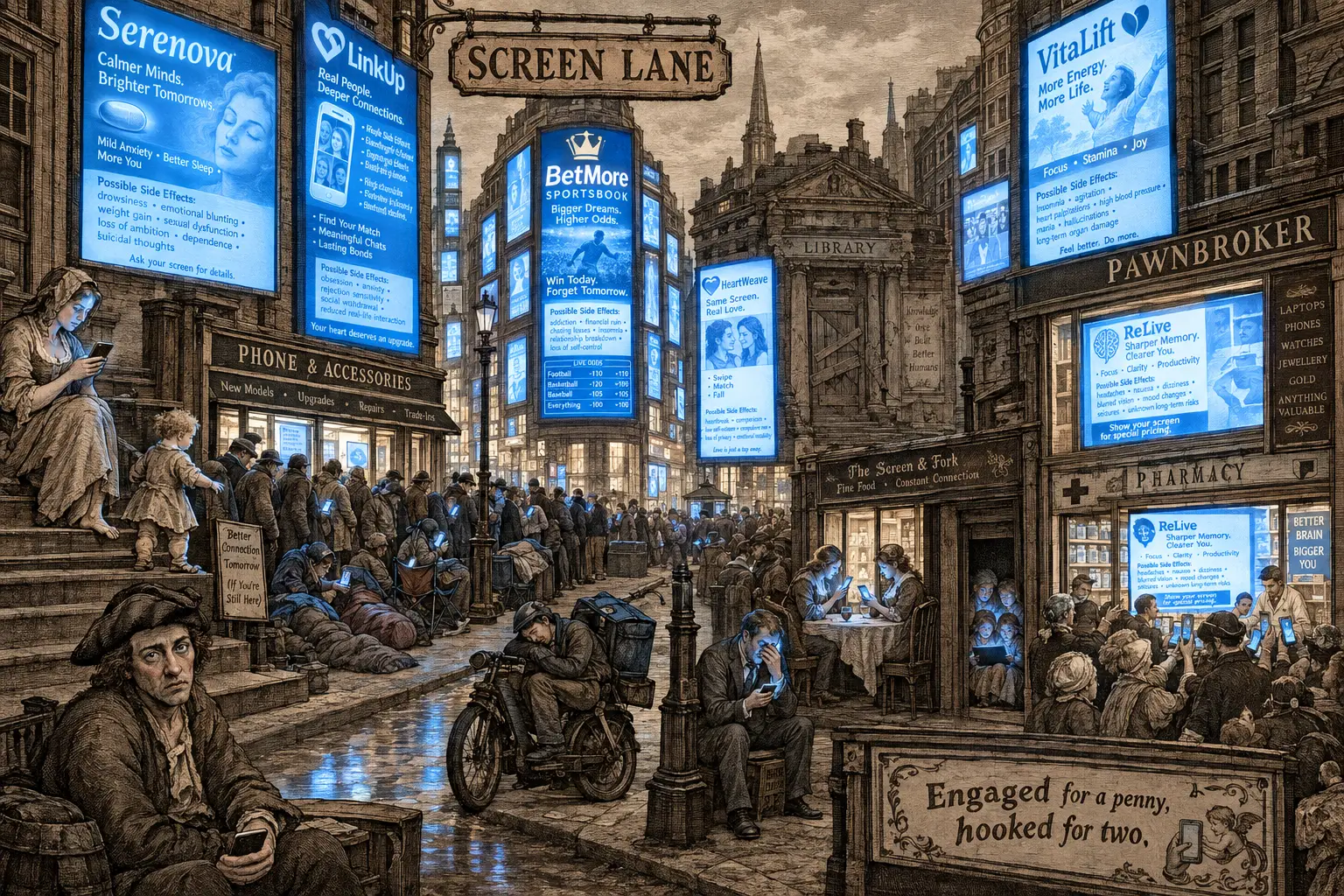
Every so often a civilization meets a technology it cannot immediately metabolize. For London in the 1720s it was cheap distilled spirit. Grain was plentiful, Parliament had made distilling nearly duty-free, and by 1743 England was producing something like eight million gallons of gin a year for a population of six million, most of it drunk in the capital. Children were dosed with it to keep them quiet. Hogarth drew Gin Lane. Preachers preached. And for the better part of thirty years nothing much happened, because the people profiting from the trade were the same people who owned the land the grain grew on.
Then the mood turned. Not the law first, the mood. Gin went from being what everyone did to being what the wretched did. The Gin Act of 1751 did not create the shift; it ratified one that had already occurred in the public mind. London sobered up, and the sobriety lasted long enough to build the century that followed.
We are living through our own gin years, and the turn is approaching.
Start with the diagnosis, because it is firmer than we pretend. Clinicians define addiction by a short list of features: tolerance, withdrawal, loss of control, and continued use despite harm. Every one of them is now documented for screens. The average adult spends about seven hours a day on connected screens, roughly forty percent of waking life. The World Health Organization added gaming disorder to its diagnostic manual in 2019; the American psychiatric manual lists internet gaming disorder as a condition awaiting further study; a network of residential clinics treats the rest under a dozen improvised names. The condition has every feature of an addiction except a name, and the reason it lacks one is not scientific. It is that a wholly separate industry, larger than the clinical one by three orders of magnitude, depends on it never being named. So let us name it. Call it engagement disorder, after the metric its manufacturers use to measure their own success. When a product's success is counted in “engagement” and its failure in “churn,” no physician is needed to say what kind of product it is.
The generations after us will not be confused about this. They will look at photographs of restaurant tables where every face is lit blue from below the way we look at Gin Lane, with pity and bafflement that anyone thought it normal. They will ask how a society that had already lived through tobacco, that had watched the Sackler family monetize pain until the courts caught up, managed it a third time with a device and a feed. The answer will be the one it always is: the people making the money were also the people writing the story about what the money meant.
The story was called progress, and its most influential author was Ray Kurzweil. His “law of accelerating returns,” proposed in 2001, held that technological improvement compounds exponentially, that the curve bends upward forever, and that the only sensible response is to get on board. It was never a law. It was a trend line fitted to one industry, semiconductors, and then declared to govern everything. Outside the chip it did not hold. American labor productivity grew about 2.8 percent a year from 1995 to 2004; in the fifteen years that followed, the years of the smartphone and the feed, it grew about 1.4 percent. What accelerated was the screen, and the doctrine of inevitability existed to make sure no one asked whether that was the same thing as progress. Strip the word “inevitable” from it and the merger of human and machine stops being destiny and becomes what it always was: a product roadmap.
Consider where the ingenuity actually went. Global advertising will pass $1.17 trillion this year, three quarters of it digital, and three companies outside China take more than half of it. Alphabet earns roughly three quarters of its revenue from ads; Meta earns nearly all of its. Between them they spend around ninety billion dollars a year on research and development, about twice the budget of the National Institutes of Health, and the commercial purpose of that research is, overwhelmingly, to make the ad land. A Facebook data scientist said it plainly in 2011: the best minds of his generation were working out how to make people click ads. Fifteen years on, that remains arguably the largest single use of applied mathematical talent on earth. Imagine it turned back toward the physical world: grids, housing, water, transit, medicine, the things that once defined what progress meant.
Here is a different story.
The internet does not disappear. It sinks. It becomes what electricity and plumbing became: a utility so reliable and so uninteresting that no one builds an identity around it. You do not “spend time on” the water main. The network runs underneath, booking the appointment, moving the money, keeping the records, stitching the logistics, and it does these things without asking to be looked at, because a utility that demands your attention is a utility that has failed. Sociology students forty years from now will study the launch-day queues outside the phone store, people camped overnight on the sidewalk for the new model, as a period spectacle, the way we now study the crowds pressing into a gin cellar for the latest concoction. It will not read as enthusiasm. It will read as a symptom. The screen recedes from the center of the room to the edge of it, as the telephone did once it stopped being a novelty and became a tool.
Advertising contracts to a fraction of its present size, not by decree but by exhaustion. The attention economy was always a temporary arrangement; it required a population that did not yet know it was being farmed. Once the knowledge is general, the yield collapses. Pharmaceutical advertising to consumers goes first. It is legal in two countries on earth, the United States and New Zealand, and in the one that matters it has grown from about half a billion dollars in 1996 to more than six billion on television alone. The American Medical Association called for a ban in 2015. Nothing about it is defensible, which is why it will be the first to go, and a society that has decided it does not want to be sold to in its living room does not draw the line at pills.
Regulation will arrive as well, and it will take a form the industry fears more than a ban. The internet is a public utility in everything but name, and the people farmed across it will eventually be owed a share of the harvest. X began paying a slice of its ad revenue to users in 2023, before any regulator required it; read that as an opening bid from someone who can see where the negotiation ends and would rather write the first draft of the terms himself. The trouble for the industry is arithmetic. Once people can put a price on their attention, those with the most money will decline to sell it, and they are precisely the audience advertisers pay for. What remains is a market of people who could not afford to opt out, worth less to advertisers every year, until the whole apparatus tips over. Insurers have a name for this. They call it a death spiral, and there is no underwriting trick that gets you out of one.
The companies that built the attention economy will, for the most part, be fine. Some will fight it and lose, as the distillers did. The shrewder ones already understand what their shareholders do not: a trusted hundred billion is worth more than a distrusted trillion. Nobody wants to be the name on the courthouse steps. Stability is cheaper than infamy, and those who can do arithmetic will pay for it, not gladly but knowingly. The rest will be made to, because the majority already wants out. More than half of Americans say they intend to cut their phone use this year. Gin drinkers said the same, and then they did.
What replaces the feed is not a return to some imagined pastoral. It is smaller and more ordinary than that. It is the dinner that runs long because nobody checked the time. It is the child who is bored on a Sunday afternoon and has to do something about it. It is the walk with no destination and no record. It is the long book, the long conversation, the long apprenticeship: every form of attention the feed was engineered to fragment. Neil Postman called the loss of these things the loss of a culture's ability to converse with itself. Recovering that ability is not a technological project. It is a cultural one, and cultures turn faster than technologies do.
The gin years ended not because gin disappeared but because London decided it no longer wished to be the kind of city that ran on it. The distillers did not lose to Parliament. They lost to a change in what people were willing to be seen doing. That is the only force that has ever ended a craze, and it is already at work.